
Repatriation abroad
Repatriation of the deceased from Switzerland to any country — by air or by hearse, to the home country, to the family, to the place that matters.
It covers collection anywhere in Switzerland, hygienic care, placing in a coffin that meets the destination country's rules, all documents and permits, and the organisation of transport to the destination airport. The final price depends on the destination country, the airline's requirements and the timeframe you need — you receive the quote in writing before we act. All prices are approximate and may change: air freight costs vary, and the price depends on the materials used – for example the coffin or zinc liner.
Request a free quoteRepatriation of a body — also called repatriation of the deceased, repatriation of remains or international transport of a body — means returning a person who has died in Switzerland to their place of burial abroad. International Bestattungen, a Swiss funeral home based in Bern, repatriates the deceased to any country, with every document handled by one firm. The key facts:
Process
A repatriation across a border is not an ordinary transport. It is governed by international agreements, by the rules of the destination country and by the airline's regulations. If one document is missing, the coffin stays at the airport.
We therefore work in a fixed order: first the permit from the Swiss authorities, then legalisation by the destination country's consulate, then the flight booking. Transport begins only once every paper is in hand.
Authorities, airlines and funeral homes use several terms for the same operation, which is understandably confusing. In short:
Which term you use makes no difference to us. Call and simply describe the situation; we will classify the rest.
Cost
Our flat rate for repatriating a body from Switzerland starts at CHF 3,000. It covers everything that happens in Switzerland. What varies greatly from case to case is the air freight: its price depends on distance and on the weight of the coffin, so we list it separately in the quote.
| Item | How it is charged |
|---|---|
| Collection anywhere in Switzerland, around the clock | included in the flat rate |
| Hygienic care and dressing | included in the flat rate |
| Coffin meeting the destination country's rules, zinc lining, sealing | included in the flat rate; the price varies with the coffin and materials |
| Obtaining all documents and permits | included in the flat rate |
| Organising transport to the destination airport | included in the flat rate |
| Air freight | separate, depending on destination, distance and coffin weight |
| Official fees and consular fees | separate, depending on the canton and destination country |
| Transfer from the destination airport to the place of burial | by arrangement with the receiving funeral home |
You receive the quote in writing before we act. Each item is explained on the page repatriation costs.
The choice depends mainly on distance. The Swiss association of funeral services notes that up to about 1,000 kilometres a hearse is often the more flexible option at a comparable price. For Germany, France, northern Italy or Austria we therefore often drive ourselves.
Beyond that, flying is the better option. For a flight the coffin must be made of wood at least 30 millimetres thick and hold a sealed zinc lining. The coffin travels as air freight; relatives can take the same flight as passengers.
Every repatriation across a border relies on a chain of documents that build on each other. This is who issues what — you need to obtain almost none of it yourself:
| Document | Issued by |
|---|---|
| Medical certificate of death | the doctor, emergency physician or hospital |
| Death certificate / extract from the death register | the civil registry office where the death occurred |
| Release of the body (only after an unnatural death) | the public prosecutor |
| Coffining and sealing record | an authorised funeral home — us |
| Mortuary passport (laissez-passer) | the competent cantonal authority |
| Legalisation, apostille, translations | depending on the country: its consulate; apostille by the cantonal authority |
| Passport or identity card of the deceased | the family — usually the only thing we need from you |
The exact order and all details are in the checklist repatriation documents.
Within Europe, repatriating a body usually takes three to five working days; outside Europe, five to ten days are realistic. Consulates and flight connections set the timetable, not the journey itself. Weekends and public holidays matter more than distance, because offices and consulates are closed. More under repatriation duration.
If the death was caused by an accident, Swiss compulsory accident insurance reimburses the necessary costs of transporting the body to the place of burial (Art. 14 of the Accident Insurance Act, UVG). Travel insurance and repatriation insurance often cover the costs too, so check the policy of the deceased. Without insurance, the costs are normally paid from the estate.
The reverse is also possible: if someone has died abroad and is to be buried in Switzerland, we organise the repatriation to Switzerland together with the funeral home on site.
If the deceased is cremated in Switzerland, the zinc-lined coffin and the air freight are no longer needed. An urn is far simpler and cheaper to transport. We discuss this openly with you. More under urn transfer abroad.
In detail
Our own vehicles
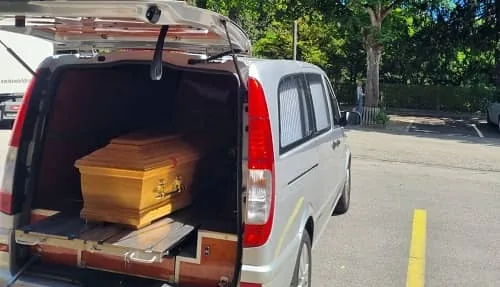
Collection in Switzerland and the drive to the airport are handled with our own funeral vehicles, not through a third party. That means fixed contacts, predictable timings and a dignified handling throughout, from the place of death to the handover to air freight.
For nearby European destinations we will, on request, drive the entire route by road. That is often faster than flying and avoids the transfer at the airport.
Questions & answers
Within Europe usually three to five working days; for destinations outside Europe, five to ten days. The consulate's processing times and the flight connections are decisive. Where a faith requires a swift burial, we arrange an accelerated process wherever that is possible.
The medical death certificate, an extract from the death register, the laissez-passer, the permit from the municipality, and the deceased person's papers (passport or identity card, residence permit). Depending on the destination country, consular legalisation, an apostille or certified translations are added. In the first conversation we tell you exactly what your case requires.
For air transport, most countries and airlines require a hermetically sealed metal coffin placed inside a wooden one. This is a rule of international transport law, not an option. The zinc coffin is included in our flat rate.
Yes. The coffin travels as air freight and relatives fly as ordinary passengers, frequently on the same aircraft. We coordinate the bookings so that arrival and handover coincide.
Yes. What matters is the place of death, not the place of residence. Even if the person was only visiting Switzerland, we arrange the repatriation.
The flat rate starts at CHF 3,000. Air freight charges and any consular fees are added depending on the destination country. We itemise each of these in the quote, so you know in advance what you will pay. All prices are approximate and may change: air freight costs vary, and the price depends on the materials used – for example the coffin or zinc liner.
Not entirely. The mortuary passport requires a coffining and sealing record, which only an authorised funeral home may issue. Without it there is no mortuary passport and no air freight.
Up to about 1,000 kilometres a hearse is often the more flexible option at a comparable cost. Beyond that, flying is faster and usually cheaper. We recommend the better option in the first conversation.
After an accident, Swiss compulsory accident insurance reimburses the necessary transport costs under Art. 14 UVG. Travel and repatriation insurance often cover the costs as well. We are happy to check this with you.
Yes. If someone has died abroad and is to be buried in Switzerland, we organise the repatriation together with the funeral home in the country concerned.